Residence Hardening: Access, Lighting, Cameras, and Safe Rooms
Residence hardening for executives, donors, and high-profile individuals. Access control, lighting, cameras, and safe rooms done with discretion, not theater.
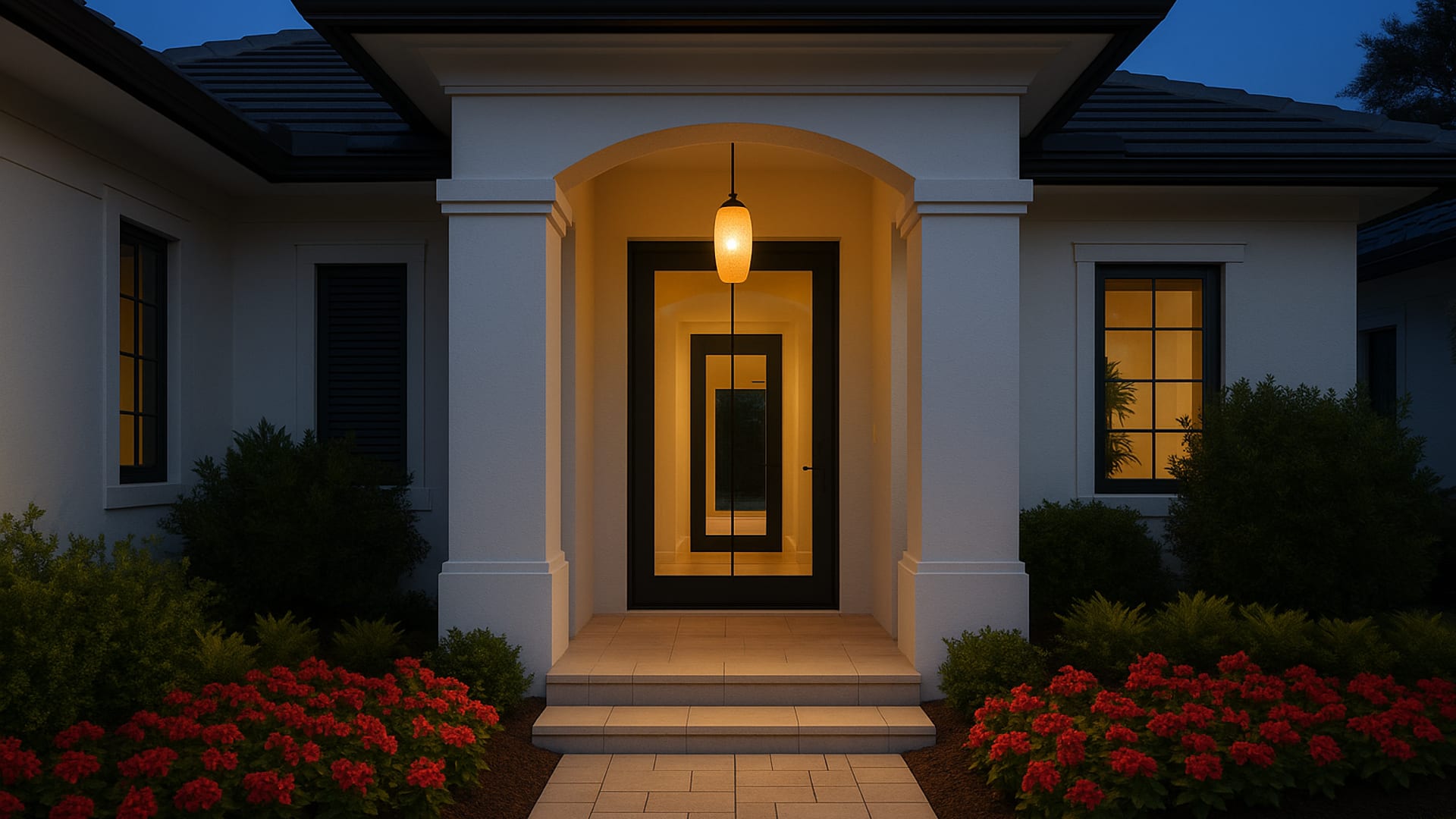
Security that looks like good taste, not armor.
Done well, residence hardening is invisible. A visitor walking up to the front door should see a well-maintained home. They should not see a fortress. The security features should read as reasonable choices that happen to also provide protection, not as theatrical defenses that signal high-value contents inside.
This aesthetic principle is not just about preference. It is operationally important. Overt security signals attract the attention of the specific threats hardening is meant to address. The best-protected residences look like thoughtfully-designed homes. The layers are there. They are just not announcing themselves.
The four layers of residence hardening.
Layer 1: Approach and exterior
Security begins before an adversary reaches the front door. The exterior layer includes:
- Lighting that covers approach routes without illuminating the interior. Warm color temperatures signal quality and deter without creating an institutional look.
- Landscaping that eliminates concealment near windows and entries, without looking neglected. Well-maintained beds with trimmed shrubs achieve this naturally.
- Exterior cameras positioned to cover approach paths and entries. Hidden is better than overt. Discrete domes blend better than obvious bullet cameras.
- Gates and driveway barriers that are calibrated to actual use patterns. A gate used daily is not a security feature if it is left open.
- Clear property demarcation (fencing, walls, landscaping) that signals ownership without aggression
Layer 2: Entries
Every door and ground-floor window is a potential entry point. The hardening considerations:
- Solid-core exterior doors with reinforced frames and heavy-duty strike plates
- High-quality deadbolts, appropriately rated for the door
- Impact-rated glass for Southwest Florida residences (hurricane code requirements often produce security-grade glass as a side benefit)
- Reinforced window frames and locks, especially for first-floor windows
- Consideration of sliding doors, which are frequently vulnerable and often overlooked
- Garage doors with appropriate locking mechanisms and controller security
The work is often not glamorous. Replacing strike plates and upgrading door hardware is dull. It is also, dollar for dollar, one of the highest-return investments in residence hardening.
Layer 3: Interior
Inside the residence, additional layers reinforce the exterior ones.
- Alarm systems with motion detection and entry point sensing, professionally monitored
- Interior cameras in common areas (not private spaces; residence cameras should preserve privacy where residents would expect it)
- Smart home security integrations, configured for intuitive use by all residents
- Safe zones identified for shelter-in-place: master bedroom, secondary bedroom, or dedicated safe room
- Communication paths: alarm panel, cellular backup, mobile devices with emergency contacts
- Key storage: never labeled, never under the mat, rotated on reasonable cadence
Layer 4: Shelter or safe room
For most households, a well-prepared shelter space is sufficient. The space should:
- Have a solid-core door with reinforced frame and deadbolt
- Include communication equipment: phone (not dependent on WiFi for critical calls), charging cable, emergency contacts
- Have basic supplies: water, flashlight, first aid, medications if needed
- Be accessible from sleeping areas without crossing the residence
- Be known and rehearsed by every resident, including children old enough to participate
Dedicated safe rooms with reinforced walls, independent air supply, and ballistic-rated construction are appropriate for specific higher-threat contexts. They are not necessary for most households.
The Southwest Florida context.
Our region introduces specific considerations for residence hardening.
Hurricane code as security benefit
Florida’s hurricane-resistant construction code requires impact-rated glass, reinforced entries, and structural hardening that produces incidental security benefit. New construction and recent renovations in Southwest Florida often start from a stronger physical baseline than homes in other regions.
Seasonal absences
Many Southwest Florida homes are second residences. Snowbirds and seasonal residents create extended vacancy periods when homes are particularly vulnerable. Hardening for these homes must account for the absence pattern:
- Monitored alarm systems that report directly to a trusted contact in the region
- Automation (lighting, window treatments) that simulates occupancy
- Trusted local contacts who check the property on a defined rhythm
- Clear mail, package, and delivery management during absences
High-visibility philanthropy
Naples, Sanibel, Marco Island, and parts of Fort Myers have concentrations of publicly visible philanthropic activity. Gala attendance, foundation participation, and major gift publicity can increase threat awareness for specific households. Hardening should account for public profile, not just physical geography.
Weather-driven threats
Hurricane Ian in 2022 demonstrated that severe weather creates non-security but adjacent risks: looters during displacement, contractor fraud during recovery, social engineering calls purporting to offer help. Residence security in SWFL must consider the hurricane context as part of the threat picture.
What we do in an executive residence assessment.
A P23 residence hardening assessment typically includes:
- Full exterior walk with attention to approach routes, sight lines, and perceived visibility
- Entry-by-entry assessment of doors, windows, hardware, and locks
- Lighting evaluation, including nighttime visit during an actual operational hour
- Camera coverage map and recommendation
- Alarm system review, including monitoring contract review
- Shelter or safe room assessment
- Household protocol review: who has keys, who has access codes, who comes to the residence
- Staff or household worker vetting review
- Consideration of online exposure (OSINT) and how it affects the residence's public profile
- Written recommendations prioritized by risk and implementation cost
The assessment is discrete. Neighbors do not need to know it is happening. Most of our work is indistinguishable from a consulting visit.
The household protocol piece.
Technology only goes so far. The household itself has to run security practices consistently. Common gaps we find:
- Keys issued to past domestic workers, contractors, and cleaners who are no longer current
- Alarm codes shared beyond the current trusted circle
- Smart home credentials that never got revoked when household workers changed
- Family members (especially adult children) who have independent access patterns that the primary household is not tracking
- Seasonal contractors (pool service, landscape, pest control) with access that has not been reviewed in years
The audit of household access credentials is one of the simplest and most productive exercises in a residence hardening engagement.
The proverb uses the imagery of the unwalled city for a spiritual truth, but the physical image is direct. A household without deliberate boundaries is a household with compromised protection. The discipline of thoughtful access control is the practical form of the spiritual counsel.
The travel integration.
Residence hardening becomes most valuable in combination with travel-related security. A secured residence that is vacant while the family travels is less protected than a secured residence with documented supervision during travel.
Our residence engagements often include travel coordination:
- Written travel protocols for household workers
- Communication channels during travel
- Emergency contact trees
- Coordination with property managers and trusted local contacts
- Pre-arrival security sweep for returns
These coordinations are part of the broader executive protection advisory, not separate from residence hardening.
What residence hardening is not.
A few honest limitations.
- It is not an absolute shield. Hardening reduces risk but does not eliminate it. Determined adversaries can defeat any specific layer.
- It is not a replacement for common sense. Posting residence photos with identifying detail on public social media undoes significant hardening work.
- It is not a substitute for training. Household members who do not know the protocols and do not practice them are households whose hardening may not help in the moment it matters.
- It is not set-and-forget. Hardening requires periodic review, maintenance, and adaptation as household circumstances change.
The conversation before the assessment.
For households considering residence hardening in Southwest Florida, we start with a confidential conversation. What is the threat profile? What is already in place? What level of investment makes sense? What should the engagement look like?
Most engagements are discreet, one-time, project-based. Ongoing relationships are available for households that want continuing advisory support.
If your household in Fort Myers, Cape Coral, Naples, Marco Island, or the surrounding areas is ready for that conversation, we would be glad to have it. No theater, no pressure, no obligation. Just a clear, honest look at what you have and what might serve you better.
Ready when you are
Advisory that fits how you actually live.
Discreet conversation about your profile, your residence, your travel, your family. Most of the work is thoughtful, not theatrical.
Start a discreet conversationRelated Insights
Keep reading.
Family Threat Briefings: The Conversation Most Executives Put Off
Family members share exposure without always sharing awareness. A family threat briefing is the conversation that closes the gap.
The Office Perimeter: Reception, Executive Suites, and Server Rooms
Hardening the executive office is different from hardening a residence. Here's how to think about reception, executive suites, and server room security.

OSINT Exposure: What a Bad Actor Learns About You in 30 Minutes
Open-source intelligence review for executives and high-profile households. What is publicly findable about you right now, and what to do about it.