Avoid, Deny, Defend: The Doctrine Everyone Should Know
Avoid, Deny, Defend is the civilian doctrine for active threats from Texas State's ALERRT program. Here's what it is, why it matters, and how it gets taught.
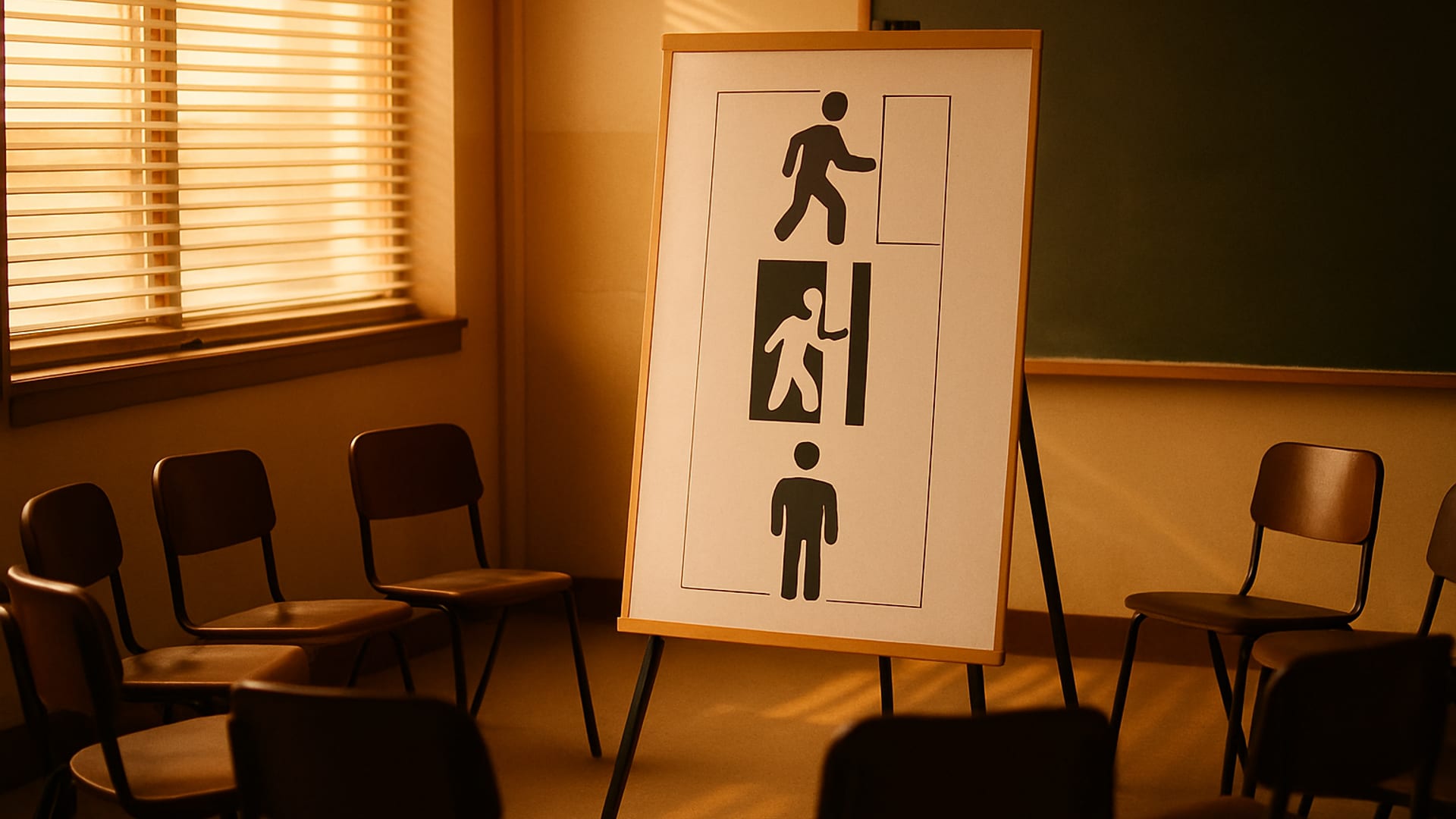
The question is never what the right answer is. It is how to think at all.
Active threat situations compress decision-making to seconds. The brain under acute stress does not perform optimization. It reaches for whatever framework it has already practiced. That is why doctrine matters. Good doctrine is not a procedure. It is a pre-loaded way of thinking that holds up when ordinary thinking does not.
Avoid, Deny, Defend is the civilian doctrine most widely taught today. It was developed by the Advanced Law Enforcement Rapid Response Training (ALERRT) program at Texas State University and is used by the FBI and many state law enforcement agencies. It replaces, or at least augments, the older Run, Hide, Fight language that dominated civilian training after 2012.
The three options, in plain language.
Avoid
Put distance between yourself and the threat. Leave the building. Move away from the area. Take others with you if you can do so quickly. Avoid requires awareness of where the exits are, where the threat is, and whether avoidance is actually possible.
Avoid is the first option because it is almost always the best option. Distance and separation are the simplest forms of safety. A person who is not in the room where the incident is happening does not have to do anything else.
Avoid is more than running. It includes:
- Awareness of exits wherever you are (the first habit to build)
- Understanding flow: which exits lead outside, which lead only to more interior space
- Calm movement, not panicked running (panic is contagious and slows groups)
- Bringing others with you when possible without delay
- Continuing to move until you are at genuine distance, not just out of sight
Deny
If avoidance is not available, deny the threat access to your location. Close the door. Lock it if possible. Barricade if necessary. Turn off lights. Silence phones. Position out of sight from doors and windows. Do not attempt to negotiate with the threat.
Deny works because most active threat actors do not spend time on locked doors. They move to easier targets. Time and distance, which avoid creates, also matter in deny. Every second of denied access is a second in which help can arrive.
Deny includes:
- Knowing which doors in your facility actually lock, and how
- Furniture and barricading options in the spaces you occupy
- Silencing devices so they do not draw attention
- Staying quiet and still until the situation is clearly resolved
- Planning for medical emergencies that may occur during the denial period
Defend
If avoid and deny are both unavailable, and you are in direct contact with the threat, defend. Use whatever tools are available. Commit fully. Defend as if your life depends on it, because it does.
Defend is the last option for a reason. It is the most dangerous. It is the only option that involves direct physical contact. It is also the one that, when it must be done, must be done without hesitation.
Defend includes:
- Using improvised weapons (chairs, fire extinguishers, bags, anything)
- Acting as a group when possible (multiple defenders are more effective than one)
- Committing to the action fully (half-commitment is more dangerous than no action)
- Continuing until the threat is incapacitated or fleeing
- Transitioning to medical care the moment the threat is neutralized
Why the language shift from Run, Hide, Fight.
Run, Hide, Fight was a step forward when it was introduced. It gave ordinary people three actions to remember under stress. That was the point, and it worked as far as it went.
The limitations became clear over years of training real civilians in real scenarios:
- “Run” suggests panic. In crowded spaces, panicked running causes injuries and blocks exits. Thoughtful avoidance is different.
- “Hide” suggests passivity. Sophisticated threats search, and a passive hide in the wrong location is worse than active denial.
- “Fight” suggests combat, which has different connotations for a civilian in an office than for a trained responder. “Defend” better captures the protective frame.
The words shape how people think under stress. “Avoid, deny, defend” produces slightly better thinking than “run, hide, fight.” Small differences matter when seconds matter.
Training structure that works.
A good Avoid, Deny, Defend training session is not a PowerPoint. It is a mix of concept instruction, spatial awareness exercises, and scenario practice.
Concept instruction
The framework itself, explained in plain language, with time for questions. Typically 45 to 60 minutes.
Spatial awareness
Walk the actual facility where trainees work. For each space, identify:
- Where are the exits, and where do they lead
- What doors lock, and how
- What could barricade a door that does not lock
- What objects could be used as improvised weapons
- Where in the room would you position to defend if it came to that
This exercise is the hinge of the training. It moves abstract doctrine to concrete facility.
Scenario practice
Brief, low-intensity scenarios where trainees have to make the Avoid/Deny/Defend decision and execute it. Not full dramatic simulations. Just enough to rehearse the mental pattern.
Debrief
After each scenario, a calm conversation about what worked, what did not, and what to adjust. The debrief is often more valuable than the scenario itself.
Role-specific adaptation.
Training should be adapted to the role of the trainee. A children’s ministry volunteer in a church has different options than a back-office administrator. A caregiver in a senior living facility has different options than a facility manager.
For church ushers and greeters:
- Awareness of the lobby and sanctuary as your primary operating space
- Exit routes for congregants, including those with mobility limitations
- Rapid denial for children's wing and classrooms
- Coordination with the safety team during active events
For daycare and children’s ministry staff:
- Evacuation routes that work with small children in tow
- Denial options for classrooms, including barricading and silencing children
- Reunification procedures that balance speed with accountability
For senior living staff:
- Avoidance options that account for mobility-limited residents
- Denial for resident rooms, common areas, and medication rooms
- Coordination with medical response needs during incidents
The Southwest Florida context.
Regional considerations for Avoid, Deny, Defend training in our area:
- Open-air facilities. Many Southwest Florida facilities include outdoor gathering spaces (church courtyards, daycare playgrounds, senior living patios). Avoidance options are often better outdoors than indoors, but require different awareness.
- Building construction. Florida’s impact-hardened construction, driven by hurricane requirements, often produces stronger walls and windows than in many other regions. This affects denial options positively.
- Seasonal crowds. Event security planning should account for the larger crowds of winter and tourism season.
- Response time variation. Urban Fort Myers has different LE response times than more rural portions of Charlotte or Lee counties. Training should reflect the realistic response window for each specific facility.
The parable is about honest preparation for difficult encounters. Jesus uses military imagery to make a point about the deeper work of discipleship. The principle applies operationally as well. Consider the situation honestly, rehearse deliberately, and act decisively when the moment arrives.
The West Freeway Church reference.
On December 29, 2019, a trained volunteer security team at West Freeway Church of Christ in White Settlement, Texas, stopped an active shooter in approximately six seconds. The team had trained together. They had rehearsed their doctrine. When the moment arrived, they executed.
The lesson from West Freeway is not about armed response specifically. It is about rehearsed doctrine. Avoid was not an option for the team members in the immediate line of fire. Deny was not available on the scale required. Defend, for them, was the only path, and they had trained for it.
For most civilians in most situations, the first two options will be the right ones. Defend is the last, and should be the last. But if it comes to that moment, rehearsal is what determines the outcome.
The training we recommend.
For organizations in Fort Myers, Cape Coral, Naples, or Port Charlotte, we recommend:
- Initial Avoid, Deny, Defend training for all staff and key volunteers, 2 to 4 hours
- Annual refresher training, 60 to 90 minutes
- Twice-yearly scenario practice, 30 to 60 minutes each
- Role-specific content tailored to the positions in your organization
- Integration with your emergency action plan, not parallel to it
- Debrief and feedback captured, so the program improves over time
Training that is general, annual-only, and lecture-based fades quickly. Training that is specific, recurring, and scenario-driven sticks.
The rehearsal saves the moment.
If you lead an organization that serves vulnerable people, training is not optional. The doctrine exists. The research is mature. The curricula are available. The only question is whether your team will have rehearsed before the worst hypothetical day arrives.
We train civilians to recognize, Avoid, Deny, and Defend with realism and compassion, not theater. If that is the training your organization is ready for, we would be glad to talk.
Ready when you are
Train the response before the day that tests it.
Taught by a combat veteran, sized for civilians. Role-appropriate, scenario-based, respectful of the people in the room.
Plan a training sessionRelated Insights
Keep reading.

Priorities of Life in a Mass-Casualty Moment
In a mass-casualty moment, care is given by priority, not by sequence. Here's how civilian responders think about who to help first, and why.
Scenario-Based Practice vs. Lecture: Why Repetition Beats Reading
Security training that sticks is training that was practiced. Here's why scenario repetition outperforms lecture, and how to build rehearsal into your program.
Stop the Bleed 101: Tourniquets, Wound Packing, and Direct Pressure
Massive bleeding is survivable if treated quickly. Stop the Bleed teaches civilians three techniques that save lives. Here's what your team needs to know.