Stop the Bleed 101: Tourniquets, Wound Packing, and Direct Pressure
Massive bleeding is survivable if treated quickly. Stop the Bleed teaches civilians three techniques that save lives. Here's what your team needs to know.
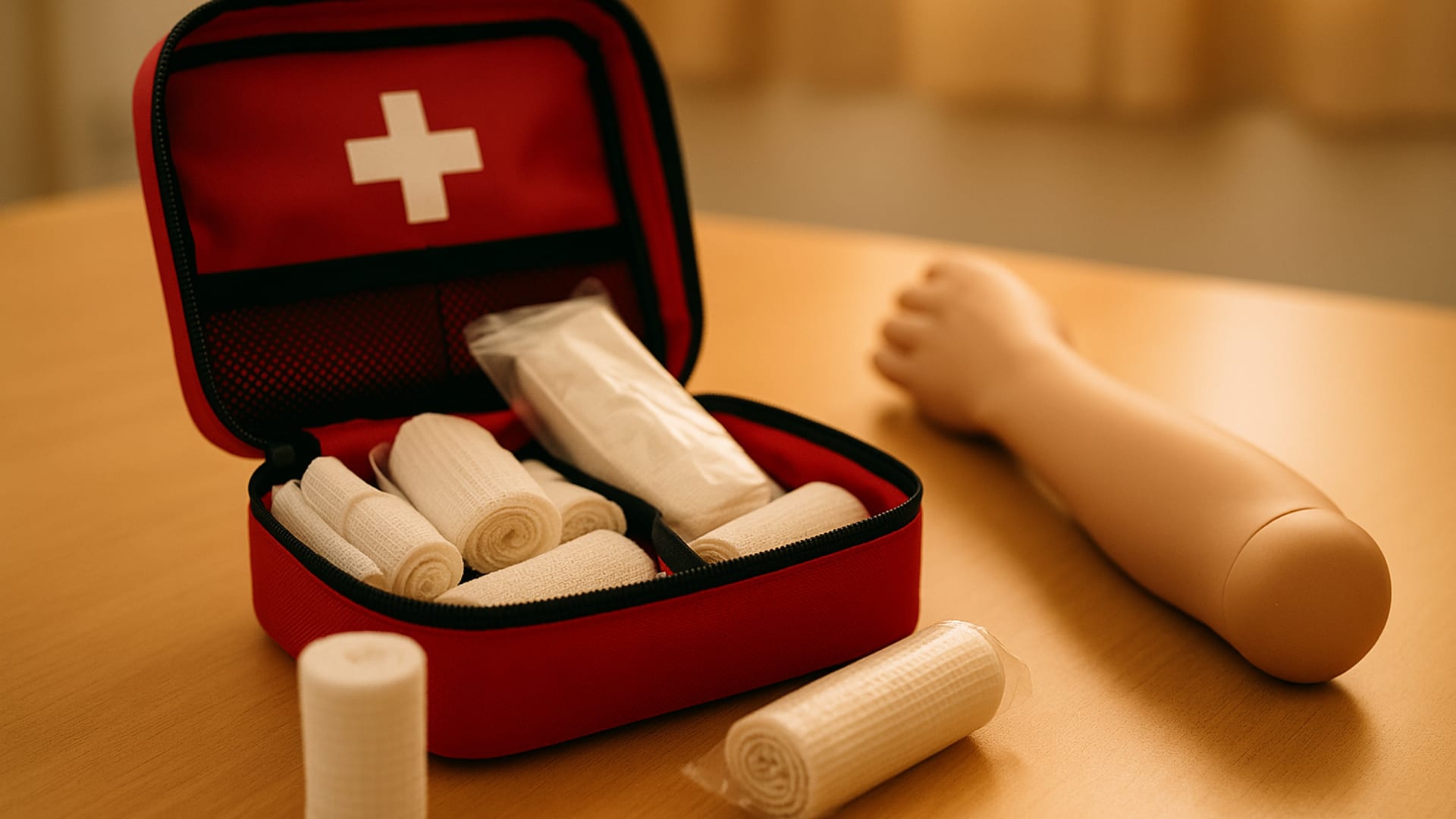
A person can bleed to death in under five minutes.
That sentence is the motivation behind the entire Stop the Bleed program. Severe bleeding from a major blood vessel can be fatal within minutes, which is almost always shorter than EMS response time. The minutes between the injury and professional care are the minutes during which someone present must act.
The good news is that the actions required are not complex. They can be taught to anyone in an afternoon. And with practice, they become reliable enough to execute under pressure.
The origin of the program.
Stop the Bleed was launched by the American College of Surgeons in 2015, with clinical leadership through the Hartford Consensus. The direct catalyst was the Sandy Hook Elementary school shooting in 2012. A review of the medical response identified that several victims who died might have been savable with earlier bleeding control.
The program now has more than 3 million people trained nationwide. It is taught by thousands of certified instructors. Kits are installed in schools, airports, offices, houses of worship, and private homes.
The program was designed to be the bleeding-control equivalent of CPR and AED training. Not a substitute for professional care, but the bridge between an injury and that care.
The three techniques.
1. Direct pressure
The default technique for most bleeding. Apply firm, continuous pressure directly on the wound with a hand, cloth, or trauma gauze. Hold it. Do not look. Do not lift to check. Just hold.
Direct pressure works for most wounds. It is the technique to apply first unless the bleeding is obviously severe enough to require tourniquet or packing.
2. Wound packing
For deep wounds on the torso, neck, armpit, or groin where tourniquets cannot be used, packing is the primary technique. Take trauma gauze (or clean cloth if no gauze is available) and pack it directly into the wound, pressing deeply while feeding more gauze in until the wound is full. Then apply firm direct pressure on top.
Wound packing is aggressive. It feels wrong to push fabric into a wound. It is the correct action for deep, heavily bleeding wounds in locations where a tourniquet is not applicable.
3. Tourniquet application
For severe bleeding from an arm or leg, a tourniquet applied above the wound can stop the bleeding within seconds. Modern combat-proven tourniquets (CAT, SOFTT-W, or equivalents) are designed for rapid one-handed application if necessary.
Application sequence:
- Apply the tourniquet 2 to 3 inches above the wound, never on a joint
- Tighten until bleeding stops. It will hurt. That is expected.
- Secure the windlass (the tightening bar) per the manufacturer's design
- Note the time of application. Write it on the tourniquet or the patient's forehead with marker if available.
- Do not loosen the tourniquet once applied. That is for EMS to handle.
- If bleeding continues, a second tourniquet can be applied just above the first.
The training sequence. In any realistic bleeding emergency:
- Ensure your own safety first. Do not enter an active threat zone to treat someone.
- Call 911 (or have someone else do so) as early as possible.
- Apply direct pressure as the default.
- If direct pressure is insufficient and the wound is on a limb, apply a tourniquet.
- If the wound is on the torso/neck/armpit/groin, pack the wound and apply firm pressure.
- Keep the patient warm. Stay with them until EMS arrives.
Where kits belong.
Stop the Bleed kits should be where injuries are most likely to occur and where trained responders are most likely to be present. A representative distribution for a mid-size church or daycare in Southwest Florida:
- Lobby and welcome area: One kit, accessible to the greeter or usher team
- Children’s ministry / classroom wing: One kit per floor, at the hallway entry
- Sanctuary or main gathering space: One kit near the primary exit
- Kitchen or commercial food prep area: One kit (knife injuries are the most common real-world cause of significant bleeding in these settings)
- Office and admin wing: One kit near the administrative hub
- Outdoor / playground: One kit mounted in a weather-sealed case accessible from the play area
Every kit should be visible, labeled, and reachable within 30 seconds by the people most likely to respond. Kits hidden in a closet are kits that do not save lives.
The Southwest Florida context.
Our region introduces specific bleeding-control considerations:
- EMS response times. Urban Fort Myers, Cape Coral, and Naples have strong EMS response, typically 6 to 10 minutes. More rural portions of Charlotte and eastern Collier counties can exceed 15 minutes. The longer the response window, the higher the value of trained civilian responders.
- Boating and water-adjacent injuries. Coastal and waterway accidents can produce significant bleeding injuries. Organizations operating near water (Fort Myers Beach, Sanibel, Marco Island) should factor this into their training.
- Hurricane aftermath. Post-storm cleanup produces high rates of laceration and impalement injuries. The period immediately after a major storm is when civilian bleeding control is most likely to matter.
- Seasonal population. Winter-season increases in foot traffic, especially at churches and event venues, correlate with higher incidence of medical emergencies. Training rhythms should account for this.
The parable of the Good Samaritan is, among many things, a description of competent civilian response. He was not a physician. He had oil and wine, which were the available tools. He knew how to use them, and he did. Stop the Bleed is the modern version of the same impulse: have the tools, know how to use them, and do not walk past the wounded.
Integration with broader training.
Stop the Bleed works best as one element of a broader civilian response capability. A staff or volunteer team trained in:
- Stop the Bleed for massive bleeding control
- CPR and AED for cardiac events
- Avoid, Deny, Defend for active threats
- Basic de-escalation for conflict situations
- Pediatric or geriatric-specific triage where relevant to the population served
…is a team that can handle the overwhelming majority of medical and security events that will actually occur in their facility. Each training is a few hours. The combined capability, rehearsed annually, is substantial.
Training in practice.
A typical Stop the Bleed training session runs 60 to 90 minutes and includes:
- Lecture on the three techniques (30 to 45 minutes)
- Hands-on practice with tourniquets and trainer kits (20 to 30 minutes)
- Wound packing practice with trainer wounds (10 to 15 minutes)
- Debrief and questions (10 to 15 minutes)
Trainees should leave the session having applied a tourniquet to a training limb at least three times and packed a trainer wound at least twice. The muscle memory from hands-on practice is what carries into real-world moments.
For organizations in Fort Myers, Cape Coral, Naples, or Port Charlotte, we deliver Stop the Bleed training as a standalone course or as part of a broader security training program. Content is adapted to the specific population the trainees serve (children, adults, seniors, mixed).
The single best investment in medical readiness.
If your organization has not trained its team in Stop the Bleed, no single other medical training will have greater return. The skills are simple, the evidence is strong, the kits are affordable, and the outcomes of successful application are measured in lives saved.
We would be glad to help plan, deliver, or integrate Stop the Bleed training for your organization. The first conversation is no-cost. The training itself is structured, hands-on, and sized for civilians who want to know they are ready when the hardest moment arrives.
Ready when you are
Train the response before the day that tests it.
Taught by a combat veteran, sized for civilians. Role-appropriate, scenario-based, respectful of the people in the room.
Plan a training sessionRelated Insights
Keep reading.
Avoid, Deny, Defend: The Doctrine Everyone Should Know
Avoid, Deny, Defend is the civilian doctrine for active threats from Texas State's ALERRT program. Here's what it is, why it matters, and how it gets taught.

Priorities of Life in a Mass-Casualty Moment
In a mass-casualty moment, care is given by priority, not by sequence. Here's how civilian responders think about who to help first, and why.
Scenario-Based Practice vs. Lecture: Why Repetition Beats Reading
Security training that sticks is training that was practiced. Here's why scenario repetition outperforms lecture, and how to build rehearsal into your program.